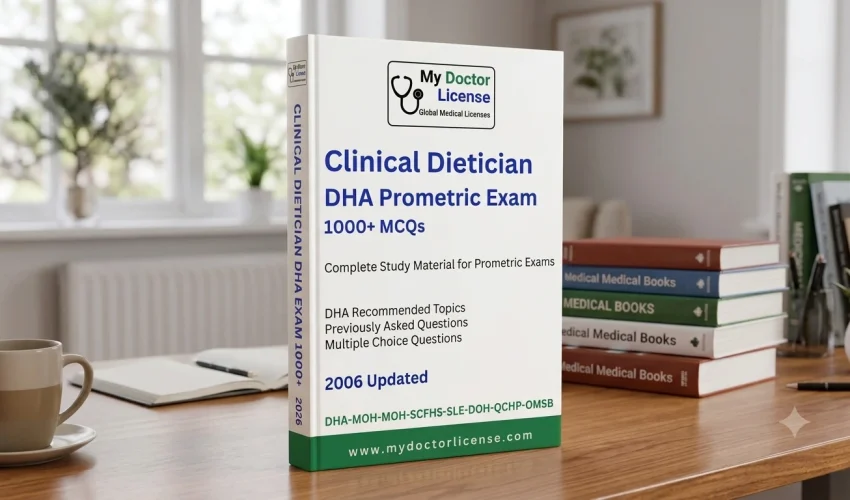
Passing the Dubai Health Authority (DHA) Clinical Dietitian Examination (Code: NUT4112) requires precise clinical decision-making, in-depth knowledge of medical nutrition therapy, and familiarity with Prometric test patterns.
This 2,000-MCQ question bank is structured to reflect the official DHA CBT blueprint, offering scenario-based questions, detailed rationales, and exact coverage across all 12 core domains.
Complete Exam Snapshot
| Parameter |
Official DHA Detail |
| Exam Title |
DHA Clinical Dietitian Examination |
| Exam Code |
NUT4112 |
| Question Format |
150 Single-Best-Answer MCQs (Computer-Based Test) |
| Duration |
3 Hours (180 Minutes) |
| Passing Score |
55% |
| Official Exam Fee |
USD $240 |
| Primary References |
Krause’s Food & the Nutrition Care Process, Understanding Normal & Clinical Nutrition (Rolfes) |
Why Prepare with This 2,000 MCQ Question Bank?
1. 100% Blueprint Alignment (All 12 Syllabus Domains)
The question bank covers all 12 domains specified in the official DHA CBT syllabus:
-
Fundamentals of Dietetics, Food Management & Services
-
Disease Prevention & Health Promotion
-
Nutrition Screening, Assessment & Counselling
-
Principles of Food Preparation & Training
-
Food Science & Normal Nutrition
-
Menu Planning
-
Procurement & Materials Management
-
Metabolic Disorders
-
Inflammatory Diseases & Cancer
-
Food Production, Distribution & Facility Design
-
Medical Nutrition Therapy (MNT)
-
Nutrition Through the Life Cycle
2. High-Yield Clinical Case Scenarios
Prometric exams test practical clinical reasoning rather than basic memorization. Questions include real-world clinical scenarios—calculating parenteral/enteral nutrition requirements, adjusting macronutrients for renal or hepatic impairment, and analyzing drug-nutrient interactions.
3. Clear Rationales & Standard Reference Text Mappings
Every question provides a step-by-step rationale explaining both correct and incorrect options, benchmarked against standard reference texts (Krause’s Food & the Nutrition Care Process, Rolfes, and ADA Guides).
High-Yield Sample MCQs
Question 1: Medical Nutrition Therapy – Chronic Kidney Disease
Scenario: A 58-year-old male with Stage 4 Chronic Kidney Disease (CKD, non-dialysis, eGFR = 22 mL/min/1.73m²) is referred for nutrition counselling. His serum potassium is 4.8 mEq/L and serum phosphorus is 4.2 mg/dL. According to KDOQI guidelines, what is the recommended daily dietary protein intake for this patient?
-
A) 0.55 – 0.60 g/kg body weight/day
-
B) 0.80 – 1.00 g/kg body weight/day
-
C) 1.20 – 1.40 g/kg body weight/day
-
D) 1.50 – 2.00 g/kg body weight/day
Correct Answer: A) 0.55 – 0.60 g/kg body weight/day
Rationale: For adults with CKD Stage 3–5 who are metabolically stable and not on dialysis, KDOQI clinical practice guidelines recommend reducing protein intake to 0.55–0.60 g/kg/day to slow progression to end-stage renal disease (ESRD) and reduce uremic toxins. Higher protein levels (>1.2 g/kg/day) are reserved for patients undergoing maintenance hemodialysis or peritoneal dialysis.
Question 2: Enteral Nutrition Support
Scenario: A critically ill 42-year-old female patient in the ICU with severe acute pancreatitis requires enteral nutrition after failing oral intake. What is the preferred site for tube placement to minimize pancreatic stimulation?
-
A) Nasogastric (NG) placement
-
B) Gastrostomy (PEG) placement
-
C) Post-pyloric / Jejunal placement
-
D) Orogastric placement
Correct Answer: C) Post-pyloric / Jejunal placement
Rationale: In severe acute pancreatitis, feeding beyond the Ligament of Treitz (post-pyloric/jejunal feeding) bypasses cephalic and gastric phases of pancreatic stimulation, minimizing enzyme secretion while maintaining gut mucosal integrity and preventing bacterial translocation.
Study Plans & Access Options
Frequently Asked Questions
What is the passing score for the DHA Clinical Dietitian Exam (NUT4112)?
The passing score is 55%. You must answer at least 83 out of 150 questions correctly within the 3-hour exam window.
Are these MCQs applicable for MOH, HAAD/DOH, and Saudi Commission (SCFHS) exams?
Yes. The clinical syllabus for Clinical Dietetics across the Gulf region (DHA Dubai, MOH UAE, DOH Abu Dhabi, QCHP Qatar, and SCFHS Saudi Arabia) shares a standardized Prometric blueprint.
How are the 2,000 MCQs delivered?
Instant online access is provided through your study dashboard immediately after enrollment. You can practice in Study Mode (with instant rationales) or Exam Mode (timed 180-minute simulations).